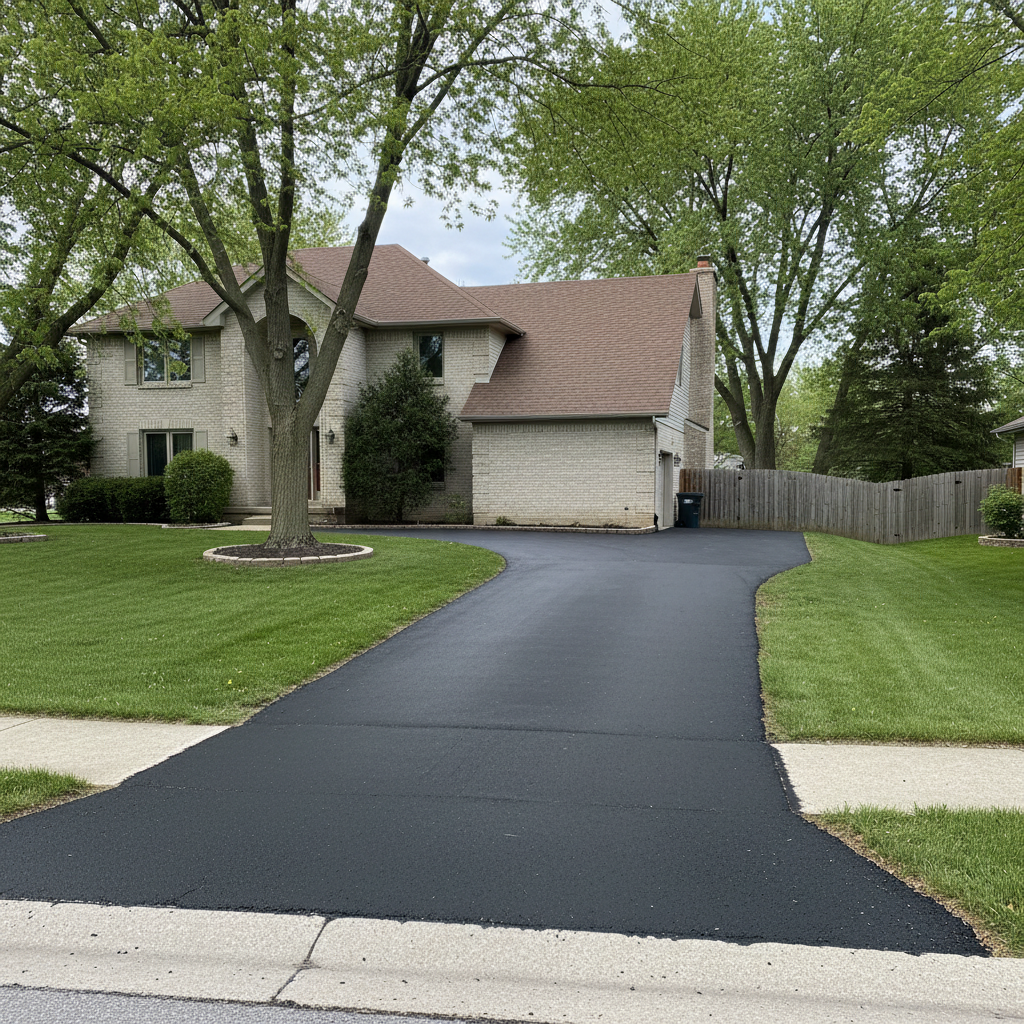
Alright, let's talk about slurry coating. It's a really smart way to protect your asphalt, whether it's a big parking lot, a private road, or even a super long driveway. But when you start looking into it, figuring out the cost can feel a bit like trying to solve a puzzle in the dark. I totally get it. You want to know what you're actually going to pay, not just some vague, hand-wavy estimate.
So, I'm going to break down what actually changes slurry coating prices right here in South Bend. We'll look at what you should expect to see on a quote, and, perhaps most importantly, how to make sure you're not getting ripped off.
What Exactly Is Slurry Coating?
Before we dive into the nitty-gritty of dollars and cents, let's quickly go over what slurry coating actually is. And no, it's not just a fancy name for sealcoating. Slurry is a lot thicker, a much tougher mixture. It's made with asphalt emulsion, aggregate (things like sand or crushed slag), water, and some other special stuff. Once it dries, it forms a really durable, skid-resistant surface that fills in those small cracks and imperfections, shields against UV rays and water, and honestly, just makes your pavement last longer. Think of it as a heavy-duty protective layer, a definite step up from your standard sealcoat.
The Big Things That Push the Price Up (or Down)
A few main things will pretty much decide how much you'll shell out for a slurry coating job. It's not rocket science, but knowing these points will really help you understand your quote.
- How Big the Job Is: This one's a no-brainer. The bigger the area, the more material and labor it'll take. Most contractors, and that includes us at Valley Asphalt Solutions, will charge by the square foot. Usually, bigger jobs get a slightly better per-square-foot rate — just makes sense, right?
- What Shape Your Pavement's In Now: If your asphalt is full of potholes, deep cracks, or has serious structural damage, you'll need repairs done *before* the slurry even goes down. Slurry coating protects; it doesn't rebuild. These repairs, naturally, add to the total cost. A surface that's been well-kept will always be cheaper to coat.
- Which Slurry Mix They Use: There isn't just one kind of slurry. There are different grades and types. Some are built for heavy traffic, others for lighter use. The specific mix picked for your project will definitely affect the material cost.
- How Easy It Is to Get To and How Complex the Area Is: Is your parking lot crammed with tight corners, islands, speed bumps, and drains? Or is it just a wide-open, rectangular space? More complicated layouts mean more careful cutting, more hand work, and more time, which all translates to higher labor costs. And if we have to work around a bunch of cars that haven't moved, that's an extra headache too.
- Site Preparation: This covers stuff like sweeping, cleaning, power washing, and crack filling. A really good prep job is absolutely critical for the slurry to stick right and last. Seriously, don't let anyone skimp on this.
- Traffic Control: For commercial projects, managing how traffic flows and keeping everyone safe during the application and drying process is a huge deal. This might involve cones, barricades, flaggers, and signs, all of which add to the overall cost.
So, What Are We Talking About, Money-Wise?
Okay, let's get to some actual numbers. For slurry coating here in the South Bend area, you're generally looking at a range. Just remember, these are estimates, and your specific project will definitely vary.
- Small to Medium Commercial (think a small business parking lot, an apartment complex drive): You might see prices somewhere in the range of $0.50 to $1.20 per square foot. This usually includes basic prep and one coat of slurry.
- Larger Commercial or Industrial (like a big box store parking lot, industrial park roads): For these bigger jobs, the per-square-foot cost can drop a bit, maybe to $0.40 to $0.90 per square foot, again, depending a lot on all those factors we just talked about.
- Repairs: If you need crack filling, expect to pay anywhere from $0.75 to $2.00 per linear foot, depending on how wide and deep the crack is. Pothole repairs are often quoted per square foot or by the patch, and those can run from $5 to $15 per square foot for smaller patches.
So, for a 10,000 square foot parking lot that's in pretty good shape, you could be looking at anywhere from $5,000 to $12,000 just for the slurry coating. But if it needs a fair amount of crack filling and a few pothole patches, that total will obviously go up, won't it?
What Should a Good Quote Include?
When you get a quote from Valley Asphalt Solutions or any other reputable contractor, it should be super clear and detailed. You shouldn't have to play guessing games about what you're paying for.
- Total Square Footage: This should be clearly written so you can easily check it.
- Scope of Work: A really detailed description of everything they're going to do. This should cover surface cleaning, crack filling (if needed, with the linear footage listed), how many slurry coats they'll apply, and any striping or marking.
- Materials Used: Sometimes they'll even specify the exact type of slurry or emulsion.
- Timeline: When they expect to start and finish, plus drying times. This is especially important in South Bend with our crazy weather; you certainly don't want rain washing away fresh slurry.
- Warranty: What kind of guarantee do they offer on their work and the materials?
- Total Cost: The final price, with absolutely no hidden fees.
How to Avoid Paying Too Much
Nobody likes feeling like they got a raw deal. Here's how to protect your wallet:
- Get Multiple Quotes: This is basic stuff, but absolutely essential. Get at least three detailed quotes from different contractors. It helps you compare apples to apples and really understand what the market rate is.
- Check References and Reviews: Ask for local references. Go look at their past work if you can. A good contractor will have a solid reputation, believe me.
- Don't Automatically Pick the Cheapest Bid: The lowest price often means they're cutting corners somewhere. Maybe they're using cheaper materials, skipping important prep steps, or they just don't have much experience. You'll end up paying for it in the long run with a coating that doesn't last.
- Ask Questions: If something in the quote isn't clear, just ask! A good contractor will take the time to explain everything to you.
- Understand the Prep Work: As I said earlier, prep is everything. Make sure the quote spells out exactly how they'll clean and prepare the surface. If they just plan to blow off some leaves and throw down slurry, honestly, walk away.
Slurry coating is an investment, plain and simple. Done right, it'll protect your asphalt for years, saving you a ton of money on more expensive repairs down the road. Just make sure you know what you're paying for and that you're working with someone who truly knows their stuff.